

Are you looking for a GDPR compliant hosting provider for your WordPress website? With data privacy regulations getting stricter, choosing the right hosting company is more important than ever.
The General Data Protection Regulation (GDPR) affects any website that collects data from European visitors. This means if you’re running a WordPress site, you need to ensure your hosting provider takes data protection seriously.
| Host | Starting Price | Best For | |
|---|---|---|---|
| Hostinger | $1.99/month | Beginners and budget-conscious website owners | Get Started |
| Hosting.com (A2 Hosting) | $2.99/month | Speed-focused websites with global audiences | Get Started |
| SiteGround | $3.99/month | Small to medium WordPress sites | Get Started |
| Kinsta | $35/month | High-traffic WordPress sites and businesses | Get Started |
| Bluehost | $2.95/month | Beginners, small businesses, and budget-conscious WordPress users | Get Started |
| Flywheel | $15/month | Designers, agencies, and creative professionals | Get Started |
What Makes a Hosting Company GDPR Compliant?
Before we dive into our recommendations, let’s understand what makes a hosting provider GDPR compliant.
A truly GDPR compliant hosting company should offer:
- Data Processing Agreements (DPAs) – Legal contracts that outline how your data is handled
- EU-based data centers or appropriate safeguards for international transfers
- Strong security measures, including encryption, regular backups, and security monitoring
- Transparent privacy policies that clearly explain data collection and usage
- User rights support, including data portability and deletion requests
- Regular security audits and compliance certifications
Compliance is a shared responsibility. The hosting company (data processor) must support GDPR requirements, but the client (data controller) is responsible for ensuring their use of the hosting service complies with GDPR, such as obtaining user consent for data collection.
1. Hostinger – Ultra-Affordable GDPR Hosting

Starting Price: $1.99/month
Free Trial: 30-day money-back guarantee
Best For: Beginners and budget-conscious website owners
Hostinger offers some of the most affordable hosting plans while maintaining GDPR compliance standards. They’ve invested heavily in security infrastructure and data protection measures.
Hostinger’s GDPR Features:
- EU data centers in the Netherlands and Lithuania
- Comprehensive privacy policies aligned with GDPR requirements
- Advanced security suite including SSL certificates and malware scanner
- Regular backups and easy restoration options
- Data processing agreements available for business customers
Hostinger Features:
- Free domain name and SSL certificate
- Custom hPanel control panel (user-friendly)
- WordPress optimization and auto-installer
- 24/7 multilingual customer support
- 99.9% uptime guarantee
Pros:
- Extremely affordable pricing
- User-friendly interface
- Good performance for the price
- Excellent customer support
Cons:
- Limited resources on basic plans
- Fewer advanced features
- Renewal prices are higher
Cons:
- Learning curve for beginners
- No domain registration or email hosting
- Limited support channels
- Flexible cloud infrastructure
- Good performance and scalability
- Competitive pricing
- Multiple server locations
2. Hosting.com (A2 Hosting) – Fast GDPR Hosting with Global Reach

Starting Price: $2.99/month
Free Trial: 30-day money-back guarantee
Best For: Speed-focused websites with global audiences
A2 Hosting offers high-performance hosting with GDPR compliance options and data centers worldwide, including EU locations.
A2 Hosting’s GDPR Features:
- EU data center options available
- Strong security measures including HackScan protection
- Privacy-focused policies and data handling practices
- Free SSL certificates and backups
- High-performance infrastructure with SSD storage
A2 Hosting Features:
- Turbo servers for faster loading times
- Free site migration service
- Developer-friendly features (SSH, Git, etc.)
- 24/7 guru crew support
- 99.9% uptime commitment
Pros:
- Excellent speed and performance
- Developer-friendly features
- Good value for money
- Global data center options
Cons:
- Turbo features cost extra
- The interface can be overwhelming
- Support quality varies
3. SiteGround – Affordable GDPR Hosting with Great Support

Starting Price: $3.99/month (first year)
Free Trial: 30-day money-back guarantee
Best For: Small to medium WordPress sites
SiteGround explicitly states its GDPR compliance and provides excellent transparency about its data handling practices. They’re an official WordPress.org recommended hosting provider.
Why SiteGround is GDPR Compliant:
- EU data centers in London, Amsterdam, and Frankfurt
- Clear privacy policies with detailed data processing information
- Free SSL certificates and daily backups
- Advanced security measures, including an AI anti-bot system
- WordPress-specific security features and automatic updates
SiteGround Features:
- Free website migration service
- WordPress staging and Git integration
- Free Cloudflare CDN
- WP-CLI and SSH access
- 24/7 customer support
Pros:
- Affordable pricing for beginners
- Excellent customer support
- Strong security features
- Official WordPress recommendation
Cons:
- Renewal prices are higher
- Limited storage on basic plans
- No Windows hosting options
4. Kinsta – Premium GDPR Hosting with Advanced Security

Starting Price: $35/month
Free Trial: 30-day money-back guarantee
Best For: High-traffic WordPress sites and businesses
Kinsta is widely regarded as one of the most GDPR compliant hosting providers in the market. They’ve gone above and beyond to ensure their platform meets all European data protection requirements.
Why Kinsta Excels at GDPR Compliance:
- Built-in GDPR tools – Kinsta even created their own free GDPR cookie consent plugin for customers
- Google Cloud Platform infrastructure with data centers across the EU
- Comprehensive DPAs available for all customers
- Advanced security features including malware scanning, DDoS protection, and automatic backups
- 24/7 expert support with GDPR knowledge
Kinsta Features:
- Managed WordPress hosting optimized for performance
- Free SSL certificates and CDN
- Staging environments and Git integration
- PHP 8+ support and automatic updates
- Daily backups with easy restore options
Pros:
- Excellent performance and reliability
- Outstanding customer support
- Advanced security features
- Built-in GDPR compliance tools
Cons:
- Higher price point
- No email hosting included
- Primarily focused on WordPress
5. Bluehost
Starting Price: $2.95/month
Free Trial: 30-day money-back guarantee
Best For: Beginners, small businesses, and budget-conscious WordPress users
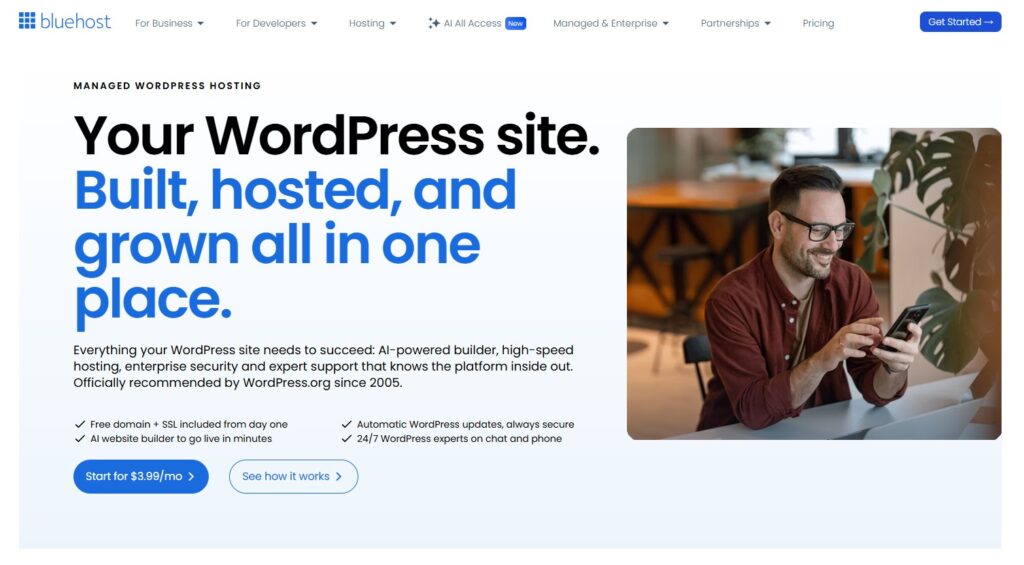
Bluehost is one of the most popular and officially WordPress-recommended hosting providers, trusted by millions of websites worldwide. They offer a straightforward approach to GDPR compliance with built-in security features, free SSL certificates, and solid infrastructure that makes it easy to meet your data protection obligations.
Bluehost’s GDPR Features:
- Data Processing Agreements (DPAs) available for businesses requiring formal compliance documentation
- Free SSL certificates on all plans to encrypt data in transit
- Domain privacy protection to shield personal data from public WHOIS records
- SiteLock security with malware scanning and automatic threat removal
- Standard Contractual Clauses for lawful international data transfers
- Built-in privacy tools and guidance for WordPress sites handling EU visitor data
Bluehost Features:
- Free domain name for the first year
- Free SSL certificate included with all plans
- One-click WordPress installation and automatic updates
- Unmetered bandwidth on most plans
- 24/7 customer support via live chat, phone, and email
- Easy-to-use control panel with WordPress-optimized interface
Pros:
- Officially recommended by WordPress.org
- Very affordable entry price for beginners
- Free domain and SSL included
- Easy WordPress setup and management
- Reliable uptime and solid performance
Cons:
- Renewal prices significantly higher than introductory rates
- Data centers primarily located in the United States
- Some advanced features locked behind higher-tier plans
6. Flywheel – Designer-Focused GDPR Hosting

Starting Price: $15/month
Free Trial: 14-day free trial
Best For: Designers, agencies, and creative professionals
Flywheel (now part of WP Engine) offers managed WordPress hosting with GDPR compliance features, specifically designed for creative professionals and agencies.
Flywheel’s GDPR Approach:
- GDPR compliant infrastructure with appropriate security measures
- Client collaboration tools with privacy considerations
- Automatic backups and easy restore options
- Security monitoring and malware protection
- Performance optimization for WordPress
Flywheel Features:
- Beautiful, user-friendly dashboard
- Free staging sites and easy migrations
- Collaboration tools for client work
- Performance caching and CDN
- 24/7 WordPress expert support
Pros:
- Beautiful, intuitive interface
- Great for agencies and designers
- Strong performance optimization
- Excellent customer support
Cons:
- Limited to WordPress only
- Higher price for basic features
- No email hosting included
How to Choose the Best GDPR Compliant Hosting
A hosting company is GDPR compliant if it adheres to the General Data Protection Regulation (GDPR), a European Union regulation for protecting personal data of EU residents. Compliance involves technical, organizational, and legal measures to ensure data privacy and security. Below are the key factors that make a hosting company GDPR compliant:
1. Data Processing Agreements (DPAs)
The hosting company must provide a Data Processing Agreement that outlines its role as a data processor (or controller, if applicable) and complies with GDPR Article 28. The DPA should specify:
Sub-processor management and compliance.
How personal data is processed.
Security measures to protect data.
Responsibilities for data breach notifications.
2. Data Location and Storage
Data must be stored in the European Economic Area (EEA) or in countries with adequacy decisions (e.g., Canada, Japan) unless appropriate safeguards like Standard Contractual Clauses (SCCs) or Binding Corporate Rules (BCRs) are in place for data transfers outside the EEA.
The hosting company should clearly disclose where data is stored and ensure compliance with GDPR’s data transfer rules (Articles 44–50).
3. Robust Security Measures
Encryption of data in transit and at rest (e.g., TLS/SSL for websites, AES-256 for storage).
Regular security audits and vulnerability assessments.
Firewalls, intrusion detection systems, and DDoS protection.
Access controls to limit who can access personal data.
Backup and disaster recovery systems to prevent data loss.
4. Data Breach Notification
The hosting company must have processes to detect, report, and investigate data breaches. GDPR (Article 33) mandates notifying the data controller within 72 hours of becoming aware of a breach, unless it’s unlikely to risk individuals’ rights.
5. Support for Data Subject Rights
Enable clients to access, modify, or delete personal data easily.
Provide tools or processes to assist with data portability.
Ensure data deletion processes comply with GDPR when requested.
6. Transparency and Documentation
How personal data is handled.
Sub-processors used (e.g., third-party services like cloud providers).
Privacy policies and terms of service aligned with GDPR.
7. Consent and Lawful Processing
t user consent where required.
Ensuring consent mechanisms are clear, specific, and revocable.
8. Sub-Processor Compliance
If the hosting company uses third-party services (e.g., cloud providers, CDNs), it must ensure these sub-processors are GDPR compliant and bound by DPAs or SCCs.
9. Data Minimization and Retention
The company must adhere to GDPR’s data minimization principle (Article 5), collecting only necessary data and retaining it only for as long as required for the specified purpose.
Clear data retention policies must be in place, with mechanisms to delete data after the retention period.
10. Employee Training and Accountability
Staff handling personal data must be trained on GDPR requirements.
The company should appoint a Data Protection Officer (DPO) if required (Article 37), especially if it processes large-scale sensitive data.
Essential GDPR WordPress Plugins to Consider
To make your WordPress website GDPR compliant, selecting the right plugins is crucial for addressing key requirements like cookie consent, data subject rights, and privacy policy management. Below is a list of essential GDPR WordPress plugins, their features, and considerations for choosing the best ones, based on functionality, ease of use, and compliance support. These plugins help ensure compliance with the General Data Protection Regulation (GDPR), which applies to websites collecting personal data from EU residents.
- Cookie Consent Plugins: Cookie Notice, Cookiebot, or Complianz
- Privacy Policy Generators: WordPress built-in tools or legal plugins
- Form Builders: WPForms, Ninja Forms with GDPR features
- Data Management: Delete Me or GDPR Data Request Form
Conclusion
Choosing a GDPR compliant hosting provider is essential for protecting your visitors’ data and avoiding legal issues. All the hosting companies in this list offer strong GDPR compliance features, but your choice will depend on your specific needs and budget.
For premium performance and comprehensive GDPR tools, Kinsta is our top recommendation. If you’re on a budget, SiteGround offers excellent value with strong compliance features. For enterprise needs, WP Engine provides the most comprehensive solution.
Remember, hosting is just one part of GDPR compliance. You’ll also need to implement proper privacy policies, cookie consent mechanisms, and data handling procedures on your WordPress site.
What’s your experience with GDPR compliant hosting? Let us know in the comments below!
Disclosure: This article contains affiliate links. If you purchase through our links, we may earn a small commission at no extra cost to you. This helps us continue creating helpful content for WordPress users.